
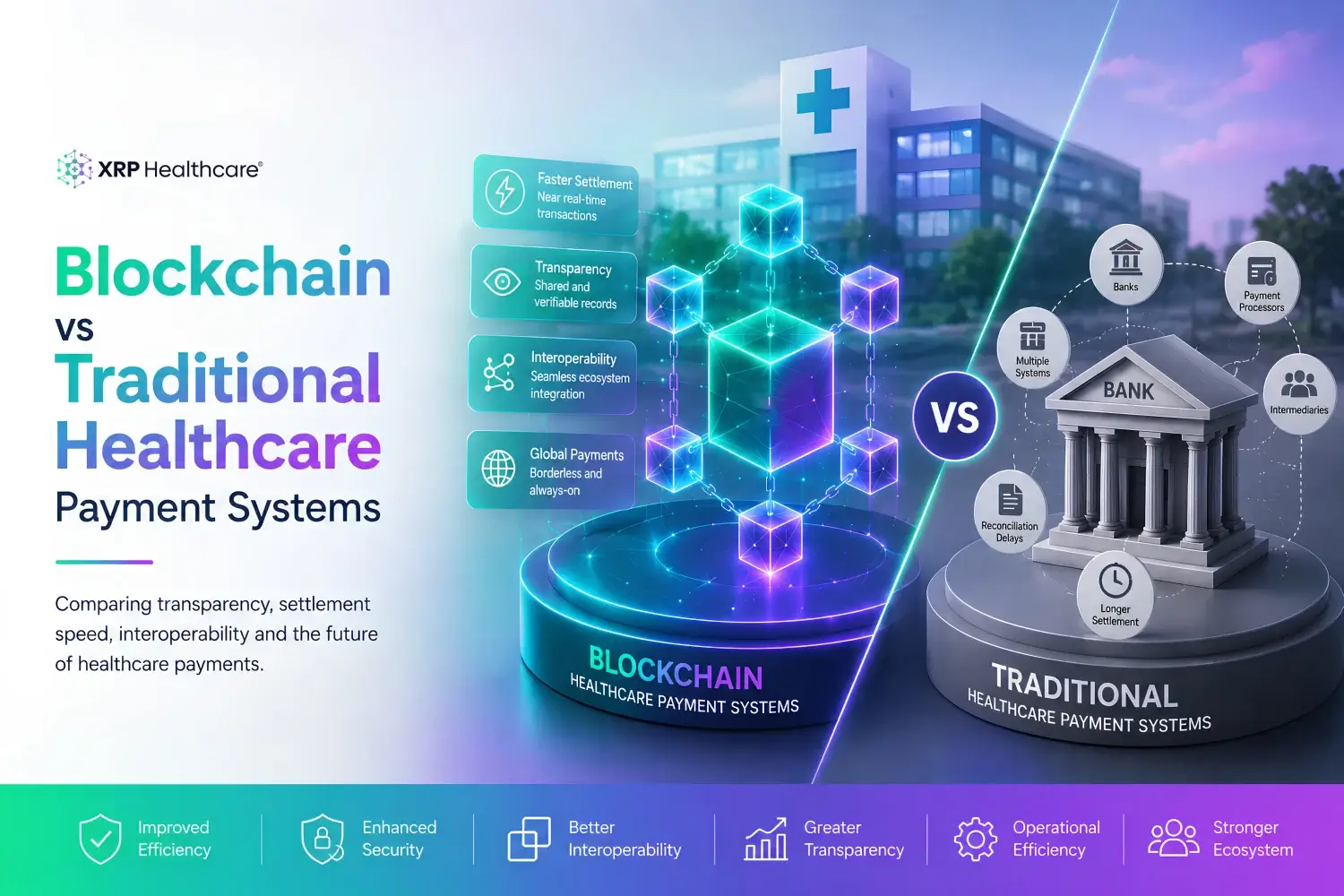
Healthcare payment systems form the financial backbone of healthcare ecosystems. Every day, payments move between pharmacies, healthcare providers, suppliers, distributors, healthcare networks and financial institutions. Historically, these payment systems have relied on traditional banking infrastructure and centralised financial processes. However, blockchain technology has introduced a new model for recording, verifying, and settling transactions.
As healthcare organisations seek greater efficiency, transparency, and interoperability, many are evaluating how blockchain-based infrastructure compares with traditional payment systems. This guide examines the key differences between blockchain and traditional healthcare payment infrastructure.
Understanding Traditional Healthcare Payment Systems
Traditional healthcare payment systems typically rely on centralised financial infrastructure. Payments often move through multiple participants, including:
- Banks
- Payment processors
- Financial intermediaries
- Settlement networks
- Healthcare finance systems
Traditional systems have supported healthcare commerce for decades and remain widely used throughout the world.
However, they can involve operational complexity, settlement delays, and reconciliation requirements.
Understanding Blockchain Healthcare Payment Systems
Blockchain healthcare payment systems use distributed ledger technology to record and verify transactions. Rather than relying on a single central authority, transaction records are maintained across a distributed network.
Blockchain infrastructure introduces:
- Shared transaction visibility
- Distributed verification
- Continuous operation
- Enhanced transparency
- Improved interoperability
- Modern settlement frameworks
These characteristics have made blockchain increasingly relevant to healthcare payment discussions.
For readers seeking foundational knowledge, see Healthcare Blockchain Payments and What Are Healthcare Blockchain Payments?
Settlement Speed Comparison
One of the most frequently discussed differences between traditional and blockchain payment systems is settlement speed.
Traditional Systems
Settlement may involve:
- Banking hours
- Multiple intermediaries
- Clearing processes
- Cross-border delays
- Reconciliation procedures
Blockchain Infrastructure
Modern blockchain networks can support:
- Near real-time settlement
- Continuous operation
- Reduced intermediary involvement
- Faster transaction confirmation
For organisations that depend on efficient cash flow, settlement speed can be an important consideration.
Transparency Comparison
Transparency remains another significant point of comparison.
Traditional Systems
Visibility may be limited across multiple participants and systems. Organisations often rely on separate records and reporting processes.
Blockchain Infrastructure
Distributed ledgers provide shared transaction histories that can improve:
- Visibility
- Auditability
- Reporting
- Operational confidence
Transparency is one reason blockchain infrastructure continues to attract interest within the healthcare sector. For additional insights, read Why Healthcare Payment Systems Need Greater Transparency.
Interoperability Comparison
Healthcare ecosystems increasingly depend on interoperability.
Traditional Systems
Integration often requires multiple systems, gateways, and communication layers.
Blockchain Infrastructure
Distributed networks may support:
- Shared transaction frameworks
- Cross-system interaction
- More efficient value exchange
- Simplified interoperability models
As healthcare ecosystems become more digital, interoperability becomes increasingly important.
Operational Complexity Comparison
Healthcare organisations are continually seeking ways to reduce operational friction.
Traditional Infrastructure
May involve:
- Multiple reconciliations
- Manual processes
- Settlement tracking
- Complex reporting workflows
Blockchain Infrastructure
Potentially supports:
- Improved traceability
- Shared transaction visibility
- Reduced reconciliation effort
- Streamlined settlement processes
Operational simplicity is becoming an increasingly important objective for healthcare organisations.
Cross-Border Healthcare Payment Comparison
Healthcare commerce is becoming increasingly global.
Traditional Systems
Cross-border payments may involve:
- Currency conversion delays
- International clearing processes
- Additional intermediary costs
Blockchain Infrastructure
Distributed networks can support:
- Borderless settlement frameworks
- Global transaction capability
- Continuous network availability
- Simplified value transfer
This is one reason blockchain continues to be discussed in relation to international healthcare payments.
Pharmacy Chain Payment Infrastructure
Pharmacy chains provide an excellent example of payment complexity.
Daily transactions may involve:
- Suppliers
- Distributors
- Logistics providers
- Healthcare networks
- Branch locations
- International procurement partners
Both traditional and blockchain systems can support these activities. However, blockchain infrastructure is increasingly being explored as a way to improve operational visibility and settlement efficiency. This trend aligns closely with developments in Healthcare Blockchain Payments.
Can Blockchain Replace Traditional Healthcare Payments?
This question is frequently asked. In reality, blockchain infrastructure is currently evolving alongside traditional payment systems. Many organisations are exploring hybrid approaches that combine existing financial infrastructure with modern blockchain capabilities. The future may involve both models working together rather than one fully replacing the other.
The Future of Healthcare Payment Infrastructure
Healthcare payment systems are expected to continue evolving.
Future priorities are likely to include:
- Greater transparency
- Improved interoperability
- Faster settlement
- Enhanced reporting
- Reduced operational complexity
- Increased automation
Blockchain infrastructure is expected to remain an important part of these discussions.
For further reading, see How Blockchain Is Transforming Healthcare Payments.
Conclusion
Traditional healthcare payment systems have supported healthcare commerce for many years and continue to play an important role. However, blockchain technology introduces new possibilities for transparency, interoperability, and settlement efficiency. As healthcare ecosystems continue to expand and digitise, organisations are increasingly evaluating how modern blockchain infrastructure may complement existing payment systems and support future healthcare payment innovation.
The continued growth of Healthcare Blockchain Payments demonstrates how healthcare payment infrastructure is evolving toward more connected, transparent, and efficient financial ecosystems.
Frequently Asked Questions
What is the difference between blockchain and traditional healthcare payment systems?
Blockchain systems use distributed ledger technology while traditional systems generally rely on centralised financial infrastructure and intermediaries.
Why is blockchain being considered for healthcare payments?
Blockchain may improve transparency, interoperability, settlement speed, and operational efficiency.
Are traditional healthcare payment systems still important?
Yes. Traditional systems remain widely used throughout healthcare ecosystems.
Can blockchain improve healthcare payment transparency?
Blockchain infrastructure can provide shared transaction records and enhanced auditability.
Can blockchain support pharmacy chain payments?
Yes. Pharmacy payment infrastructure is one of the most commonly discussed healthcare blockchain payment use cases.
Will blockchain completely replace traditional healthcare payment systems?
Most experts expect blockchain and traditional infrastructure to coexist for the foreseeable future.
Related Articles
- Healthcare Blockchain Payments
- What Are Healthcare Blockchain Payments?
- How Blockchain Is Transforming Healthcare Payments
- Why Healthcare Payment Systems Need Greater Transparency
- The Future of Healthcare Blockchain Payments (Coming Soon)